Tuesday, 24 October 2017

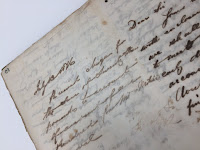
C19th Edinburgh Sloan & Son letters discovered

Just legible 'Letter Book No.' 
I rarely walk past any bookshop without dropping in for a mooch, usually heading straight for the history, art, and antiquarian sections. A favorite is the Oxfam Bookshop on Park Street in Bristol. We visited on Saturday and I immediately spotted a largish, timeworn tome that smells beautifully of musty aged paper with a tinge of aromatic wood fire smoke.


The worn peeling label on the spine just about spells 'LETTER BOOK No.' embossed in tarnished gold. No number.


Inside, the first carefully cut pages are alphabetically marked as an index to numerous names and addresses. Twenty Four letters of the alphabet, with the exception of X but an additional Mc. Ah, we are in Scotland!


The next delight to discover are the following 500 pages. Fragile, translucent tracing paper with neatly copied correspondence, all in seeping sepia ink.


If you desire to know how much a wagonload of furniture would cost to transport from Liverpool to Waterbeck in 1870 this is the place to find out. '£30 per wagonload and 80 shillings per ton for loose goods' now you ask. 'This sum includes all necessary packing, housing, Railway and other charges.' Insurance is more, costing '20 per cent more'.


This delightful company, Sloan & Son, latterly of Queensferry, are 'ever true' 'sincere' and 'at your service’ although they can get a little snippy if you owe them.


I have only just begun to read the letters and spotted somewhere the cost per ton of transporting a consignment of marble pillars to a construction site, and a letter regarding the Royal Infirmary in Edinburgh.

The letters date from around 1860 to 1883 and include Captains, Revs, and more ordinary folk who could afford their services.

I recognize many Edinburgh addresses, and in the fullness of time look forward to exploring the letters in more detail, and researching Sloan & Son of Edinburgh.

If anyone can help point me towards any information or research material I would love to hear from you.


Can you spot the Mc. tab?
       

Tuesday, 19 September 2017

Can you identify this 1920's family?


Can you identify the family or locations in these 1920’s stereoscope photographs?


During our customary month long stay at the Edinburgh Fringe Festival last August I decided 
to take an online course on the development 19th century stereoscopes. It was a fascinating and informative course enhanced by being delivered by the University Of Edinburgh. I could pop into the National Museum Of Scotland and had seen a linked exhibition in 2015.


I decided keep an eye out for a stereoscopic viewer whilst browsing in antique and charity shops as I wanted to experiment with stereoscope images for my artwork.


19th century stereoscopes are magnificent beasts but not always the most portable or storable objects, so I was delighted with a recent find.


Last week at the corn street antiques market in Bristol the first thing to catch my eye was this little portable viewer. A later date than I really wanted but the moment it was in my hand I knew it was mine. The weight, the materials, the texture. The mechanism  pops up and folds down into perfect pocketable portability.
I glanced at the double photographs within and struck a good deal with the stall-holder.


The first photograph in the pile was the jolly little boy looking cheekily towards the camera. I was further enchanted by the enormous polar bears at a zoo, frozen forever in their cramped mock Arctic environs.


Please do take a moment to look at the photographs. It looks as if the family are on holiday, a day out at the very least, precious enough to immortalise with a stereoscopic camera and processed as postcards. I have a feeling the beach may be in South Wales, perhaps the zoo and castle are there as well?


Do let me know if you recognise any of the family or the locations. I’d love to know where they are and if you may be related?


Images & text ©Heather Tweed 2017

Pens And Post Boxes Images Of Birmingham Jewellery Quarter


If you are not a magpie attracted to shiny things, or into expensive bling, you may think that Birmingham's Jewellery Quarter is not for you? Stroll around the historic industrial architecture and pay a visit to the fascinating pen museum and you may discover a few surprises.
penmuseum.org.uk


All images © Heather Tweed 2017

Monday, 4 September 2017

3 reasons I ❤️Venice Vending Machine Art Installation

Having recently joined the team at ART-E-MOTION I would like to share my reasons for loving the Venice Vending Machine installation. Scroll down for details on the artist call and how to help keep the project free for everyone.


1. Marina Moreno: Instigator of the installation, Venetian live-art artist Marina is a magical motivator, full of passion for her project and keeping art open to all.

 
Marina oversees the Venice Vending Machine


2. The Concept: An international Art Vending Machine with a mission to invite the casual visitor to question how much a piece of artwork is worth. A participatory, inclusive artwork that functions on multiple levels without dumbing down.


www.venicevendingmachine.com


3. The Location: Picture-book-Venice during the Biennale need I say more?

A lucky visitor collects her prize of artwork


How much would you pay for a piece of artwork? That's the question artist and curator Marina Moreno will be posing at the Venice Biennale in October.
       
In return for a response to her question Marina will use a symbolic token to activate a large vending machine, brim-full of circular pods each carefully packed with a piece of selected artwork. In this playful exchange, visitors to the gallery can then enjoy popping open the pod to discover their surprise free artwork to take away and treasure.
       
Marina believes that art is something that can, and should be experienced by anyone. Alongside arts professionals, curators and collectors, her Venice Vending Machine installation attracts many people who are not in the habit of visiting more traditional art galleries.
       
Drawing from her live art background, Venice born Marina opens a dialogue to the visitor by posing the question: “How do you value art?”. A simple monetary figure is sometimes the response, the social and philosophical value of art in society are sometimes debated. Marina is open to all suggestions.   As she explains: “Through the game of interaction and the inherent chance of the machine,(an automatic distributor) an exchange takes place for both the artists and the receiver of the art work. The Venice Vending machine is a serious reflection on the dynamics of the art market and the function of the gallery. The surprise and subversion of pre-established rules.”
       
To keep the project free for her growing audience and the artists involved this year she has set up a crowdfunding campaign where rewards include lots of goodies ranging from a Thank You postcard to a printed catalogue to a top of the range package including an invitation to the private view and named ‘Angel’ status across published media.
       
The project is expanding and Marina is excited to be invited by the prestigious GAA Foundation to show her Venice Vending Machine at this years festival, hosted by the Seychelles Pavillion at Giardini della Marinaressa.
       
She is also keen to open up new opportunities for artists and the selected artwork includes some unique and limited edition pieces produced by both established and emerging artists. 250 artists have participated since 2010 in Hamburg and Venice and she is putting out a call to artists across the world to apply for this special opportunity.

 So what would you pay for a piece of artwork? Visit the Vending Machine installation at the 57th Venice Biennale 14th - 22nd October 2017 Giardini della Marinaressa, Martiri 30122

For details, updates on venue, and artist opportunities please visit www.venicevendingmachine.com


GAA Foundation: www.gaafoundation.org

Friday, 28 April 2017

Lloyds Bank Law Courts Branch; Twinings, Tweed, an unexpected part 2


In my last post I wrote a little of the beginnings of Twinings Tea Merchants their bank  and the link with my family tree.
Last week I happened to walk past Lloyds on the Strand and popped in to take a closer look.


Twinings bank was first established to offer a selection of financial facilities to family and friends. Initially part of the thriving tea company it soon became successful enough to become a separate business in its own right.

In 1824 the lone clerk, sat at his high desk squeezed alongside the safe in his tiny office. Delicious aromas of tea and coffee wafted through the door from Devereux Court as he exchanged cheques for cash, weighing out expensive fine tea or coffee as part of the deal if required.


Soon many merchants from outside the family circle were using the expanding bank. New, larger premises were required and the Twining’s built a new establishment beside their tea shop on the Strand in 1835, a very suitable arrangement as their tea trade supported the bank safely through several national financial crises.


As the 19th century progressed many smaller banks combined and swelled their coffers to cover ever larger areas. In 1892 Lloyds put in an offer to take over Twining’s Bank. At the time Richard Twining And Co consisted of six partners, each being listed as ‘Banker and Tea Man’* with Arthur James Tweed and Charles Twining Sidgwick both living at the bank’s address, 215 Strand.

Across the road from Twining’s and the bank, the Royal Courts of Justice long rebuild was completed in 1882. Bigger and grander than its ancient predecessor, it was felt that a new restaurant was needed to match it’s splendour. The chosen spot was at 222-225, where the once famous Palsgrave Head Tavern had stood.

The splendidly titled architects Wimble and Cuthbert created a magnificent outer lobby using Royal Doulton ware, majolica style ceramics and intricate arabesque mosaics. Through the doors the interior lobby is richly decorated and wood clad. John McLennan designed images for large conjoined Doulton tiles, including Ben Johnson characters, fashionable golden chrysanthemum types from the nearby Temple Gardens, and Frederick Palsgrave (husband of Elizabeth Stuart, Queen of Bohemia) reflecting the history of the previous tavern.

The restaurant failed to attract its target audience of barristers, judges and upper class clients from the Royal Courts of Justice despite the obvious draw of a ventilation system powered by two women on a tandem!The business failed twice and Lloyds took over the building in 1895. Richard Twining became a director at Lloyds and retired two years later at the grand age of 90.

The branch is due to close in August, if you are passing it’s well worth a visit to admire its sumptuous interior, who knows what it’s future holds?


*Supplement to the London Gazette, Feb 1892


Information display inside the branch at 222-5 Strand.
http://www.lloydsbankinggroup.com/Our-Group/our-heritage/2015-our-milestone-year/250-years-of-lloyds-bank/branch-stories/law-courts-london/
http://tilesoc.org.uk/tile-gazetteer/westminster.html
http://londonist.com/2016/09/is-this-london-s-most-beautiful-bank
https://www.innertemple.org.uk/index/the-inner-temple-garden?showall=&start=1
http://chestofbooks.com/gardening-horticulture/Gardener-1/index.html